Well, I guess it's time to continue my rants and somewhat informative blog series about Soviet architecture.
Today, I will start to work and explain the next era in the Soviet Union's respective eras on architecture and art. This would be the days of Stalin, and how his own insanity and ideological differences with the revolution destroyed the relative freedom that the revolution gave to architects and artists and how his style had a lasting legacy on the many skylines of cities all around the Eastern Block.
A Stalinist poster. Propaganda posters such as these became more and more commonplace as the freedom and ingenuity of the Constructivist Era slowly eroded away against Stalin's own personal taste.
As Stalin took power in the late 1920's, The Soviet Union was a bit different from the more darker and stereotypical view that many in the West had about the country. The country didn't have the massive collectivised farms that was typical in the countryside. Small private enterprises existed alongside state enterprises as the New Economic Policy (NEP) began the road to recovery for the country's economy after the chaos of the First World War and the Russian Revolution.
The rise of Stalin to General Secretary of the Party began the long road for his own vision of Russia to start and flourish. Socialist Realism became the only allowed and endorsed style of art in the intellectual and academic circles. Socialist Realism was a style that was created in the country as many in the Communist Party deemed earlier art styles such as Impressionism and Cubism as "decadent bourgeois art". Socialist Realism became official state policy in 1932 linking its art styles to the Stalinist ideology that the government at the time championed.
Spring Day by Nikolai Podzneev. This painting was one of the styles that was common throughout art of the Socialist Realism style which gave more of an emphasis on the lives of the proletariat.
In the world of architecture, the avant-garde and futuristic styles of Constructivism utterly disappeared in Stalin's reign of the country only to be replaced by the imposing style of the Neo-Renaissance buildings that dot Moscow today. Almost all of these buildings were usually associated with the Socialist Realism school of art and architecture which at this time was the only art style allowed in the country.
The Moscow Metro. The first lines were built in the 1930's giving the metro's stations a grand and imposing feeling to all those who walk amongst its halls, something that Stalinist architecture was meant to do.
Stalinist architecture took a more international approach by the end of the second world war as Soviet influence spread from Berlin to Beijing bringing this art style towards many of the Communist states that arose out of the war. Beijing's Tiananmen Square's buildings, which were built in the tenth anniversary of the Communist victory in the Civil War resemble this. As the Stalin's Soviet Union arose to superpower status, the nation's art arose to international prominence as well.
The University of Moscow, one of the "Seven Sisters" that dominated Moscow's skyline.


.jpg/800px-%D0%92%D0%94%D0%9D%D0%A5_(%D0%93%D0%BB%D0%B0%D0%B2%D0%BD%D1%8B%D0%B9_%D0%B2%D1%85%D0%BE%D0%B4).jpg)
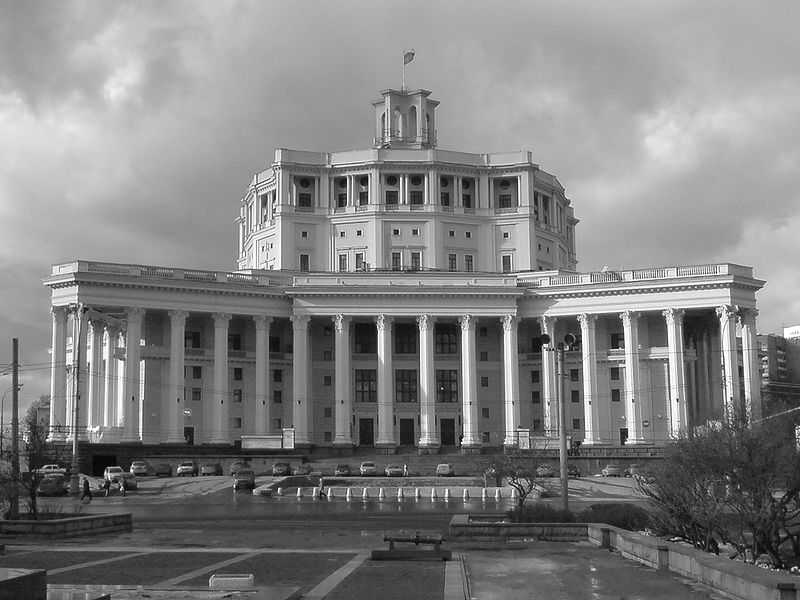
 The Red Army Theatre in Moscow




.jpg)
